Why This Opportunity Matters for Experienced Coders
After gaining experience in medical coding, the next important step is choosing the right organization that offers:
- Career progression
- Exposure to multiple specialties
- Better learning opportunities
- Long-term job stability
This hiring opportunity is ideal for coders who want to move beyond routine work and expand their expertise in high-demand specialties.
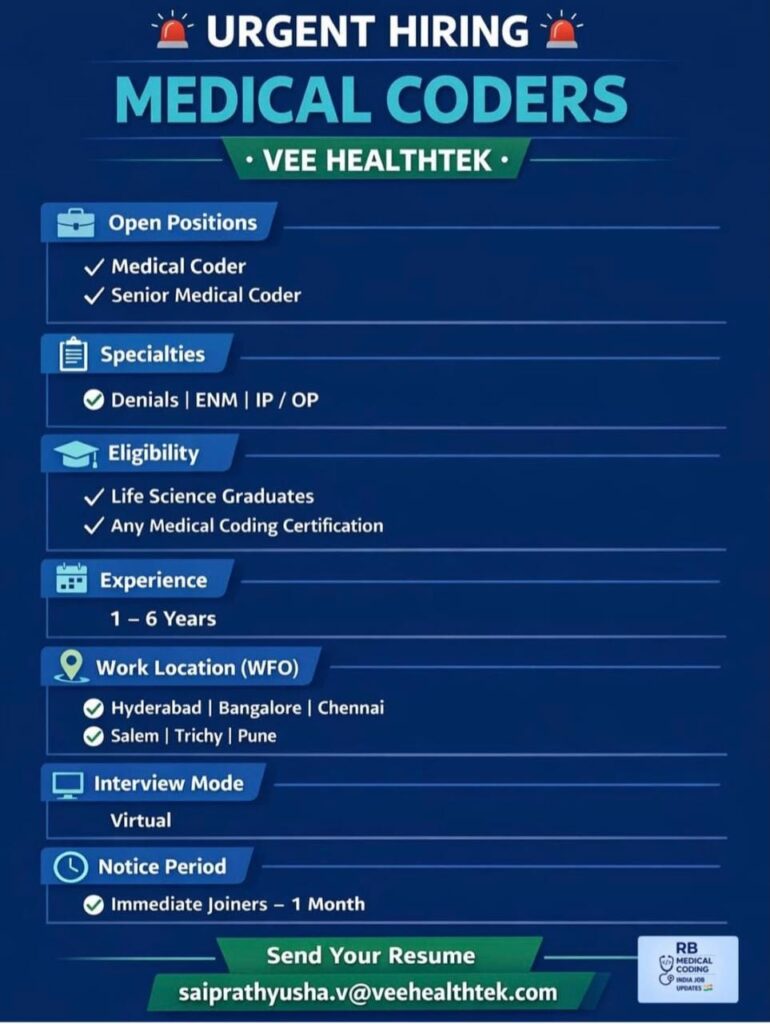
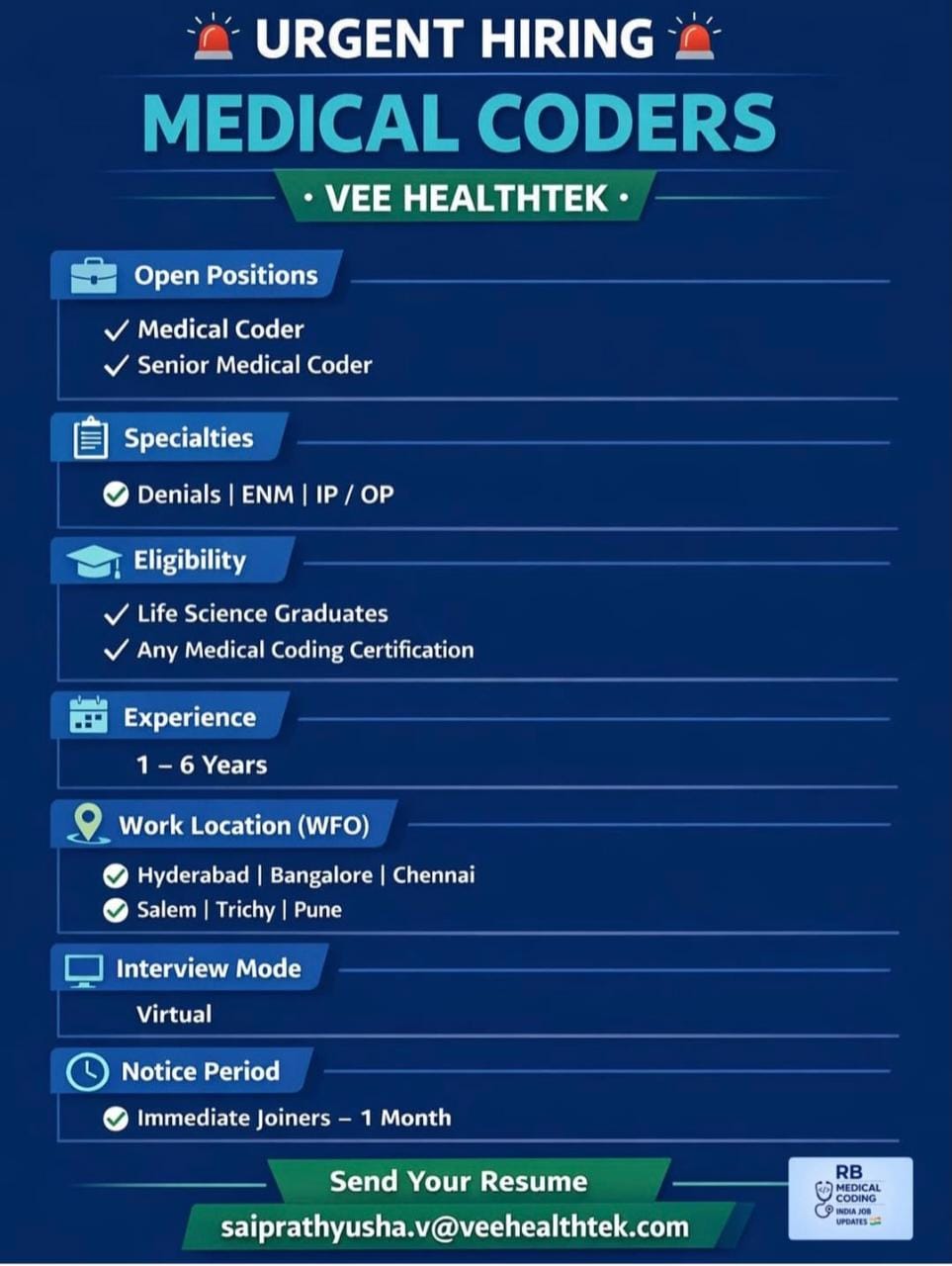
Open Positions
VEE Healthtek is hiring for the following roles:
- Medical Coder
- Senior Medical Coder
These roles are designed for professionals who already understand coding guidelines and want to enhance their career path.
Required Specialties
The company is actively hiring coders with experience in:
- Denials Management
- E&M Coding
- Inpatient Coding (IP)
- Outpatient Coding (OP)
These specialties are among the most important and demanding areas in the coding industry.
Denials Coding
Professionals with denial management experience play a critical role in revenue cycle management. This specialty requires strong analytical skills, payer guideline knowledge, and attention to detail.
E&M Coding
Evaluation and Management coding remains one of the most sought-after skills in the industry. Experienced E&M coders are valued for their knowledge of documentation guidelines and compliance.
Inpatient Coding (IP)
Inpatient coding is considered an advanced specialty. Coders with IP experience are highly respected due to their expertise in complex medical cases and DRG assignment.
Outpatient Coding (OP)
Outpatient coding requires strong CPT and ICD-10-CM knowledge and is essential for hospital and clinic billing processes.
Professionals with experience in any of these areas are encouraged to apply.
Eligibility Criteria
To qualify for this opportunity, candidates must have:
- Life Science Graduation
- Any Medical Coding Certification (CPC, CCS, CCA, or equivalent)
Certification combined with real-world coding experience makes candidates highly competitive.
Experience Requirement
This hiring drive is for candidates with:
1 to 6 Years of Medical Coding Experience
This range is ideal for:
- Junior Coders ready for growth
- Experienced Coders seeking better opportunities
- Senior Coders looking for leadership paths
Work Locations (Work From Office)
Positions are available across multiple cities:
- Hyderabad
- Bangalore
- Chennai
- Salem
- Trichy
- Pune
Candidates open to relocation will have access to more opportunities.
Interview Process
The hiring process is Virtual, making it easier and faster for candidates to attend interviews from anywhere.
Notice Period
Preferred candidates:
- Immediate Joiners
- Up to 1 Month Notice Period
Candidates who can join quickly will have an added advantage.
Career Growth Opportunities
Joining a reputed healthcare organization can significantly accelerate your career growth.
Potential career path includes:
- Medical Coder
- Senior Medical Coder
- Quality Analyst
- Auditor
- Trainer
- Team Lead / Manager
Experienced coders can expect continuous learning, exposure to global clients, and opportunities to move into leadership roles.
Why You Should Apply Now
If you already have coding experience, this is the perfect time to explore new opportunities that offer:
- Career advancement
- Exposure to high-demand specialties
- Professional growth
- Long-term stability in the healthcare industry
The demand for skilled coders continues to grow, and the right opportunity can accelerate your career journey.
How to Apply
Interested candidates can send their updated resume to:
saiprathyusha.v@veehealthtek.com
Medical Coding Interview Questions – What Experienced Coders Should Prepare
When you apply for a new coding job, the interview usually checks three main areas:
- Coding knowledge
- Guideline understanding
- Real-time scenario thinking
For experienced coders, interviewers expect practical answers, not textbook definitions.
Below are the most commonly asked questions in medical coding interviews.
General Questions for Experienced Coders
These questions test your real work experience.
Common Questions
- Tell me about your coding experience.
- Which specialties have you worked in?
- What coding systems do you use daily?
- How do you maintain coding accuracy?
- How do you handle productivity pressure?
- What steps do you take before finalizing a code?
👉 Tip: Always explain your daily workflow and quality process.
Example answer idea:
- Review documentation
- Check guidelines
- Assign ICD + CPT codes
- Follow payer policies
- Perform self-audit before submission
ICD-10-CM Interview Questions
These questions test diagnosis coding knowledge.
Most Asked Questions
1. Difference between principal diagnosis and first-listed diagnosis
- Principal diagnosis → Inpatient setting
- First-listed diagnosis → Outpatient setting
2. Sepsis Coding Questions
Very commonly asked!
Example scenario:
Patient admitted with pneumonia and develops sepsis.
Expected discussion points:
- Underlying infection sequencing
- Sepsis guideline rules
- Severe sepsis vs sepsis difference
3. Combination Codes
Interviewers often ask:
- What is a combination code?
- Give examples.
4. Chronic vs Acute Coding
Example:
Acute respiratory failure with COPD exacerbation
Which condition should be sequenced first?
They check your guideline knowledge here.
CPT / E&M Interview Questions
E&M questions are very common.
Frequently Asked Questions
1. What are the components of E&M?
- History
- Examination
- Medical Decision Making (MDM)
2. What determines E&M level in 2023 guidelines?
Answer:
👉 Medical Decision Making or Total Time
3. Difference between New and Established Patient
- New → No service in last 3 years
- Established → Seen within last 3 years
4. Time vs MDM selection
When do you choose time?
When do you choose MDM?
Denial Coding Questions
For denial coders, interviewers test problem-solving skills.
Common Questions
- What are the common denial reasons?
- How do you fix coding denials?
- Difference between coding denial and billing denial?
- What is medical necessity denial?
You should mention:
- Documentation review
- LCD/NCD check
- Payer guideline review
- Correct resubmission
Inpatient Coding Questions (IP)
These are asked to check advanced knowledge.
Most Common IP Questions
1. What is DRG?
Diagnosis Related Group used for inpatient reimbursement.
2. Query Process
- When do you raise a physician query?
- Types of queries?
- Compliant query vs non-compliant query?
3. Present on Admission (POA)
Very important inpatient topic.
Outpatient Coding Questions (OP)
Frequently Asked Questions
- Difference between inpatient and outpatient coding
- What is modifier usage?
- Most commonly used CPT modifiers?
Important modifiers to revise:
- Modifier 25
- Modifier 59
- Modifier 26
- Modifier TC
Scenario-Based Questions (Very Important)
Experienced coders are always asked scenarios.
Example scenario:
Patient comes to ED with chest pain, diagnosed with MI, admitted as inpatient.
What will you code?
Interviewers check:
- ED vs IP understanding
- Sequencing knowledge
- E&M knowledge
Productivity & Quality Questions
These questions check your work performance.
Common questions:
- What is your daily productivity?
- What is your accuracy percentage?
- How do you handle audits?
- Have you worked with QA feedback?
Tip: Always mention:
- Productivity per day
- Accuracy above 95% (if applicable)
- Self-audit habit