
In today’s rapidly growing healthcare industry, medical coding has become one of the most in-demand and respected career paths. With hospitals, emergency departments, and insurance companies depending on accurate clinical documentation, skilled medical coders are essential for the smooth operation of the entire healthcare system.
If you are an experienced medical coder looking for a stable and rewarding on-site position, Doctus Data Services has announced an excellent opportunity. The company is hiring for the role of Senior Medical Coder – ED Facility & Professional. This is a great chance for individuals who have strong expertise in Emergency Department coding and want to advance their career with a reputed organization.
In this blog, we will provide complete details about the job, eligibility criteria, skills expected, and how you can apply. This article is designed to help candidates understand the job profile clearly and prepare for the opportunity
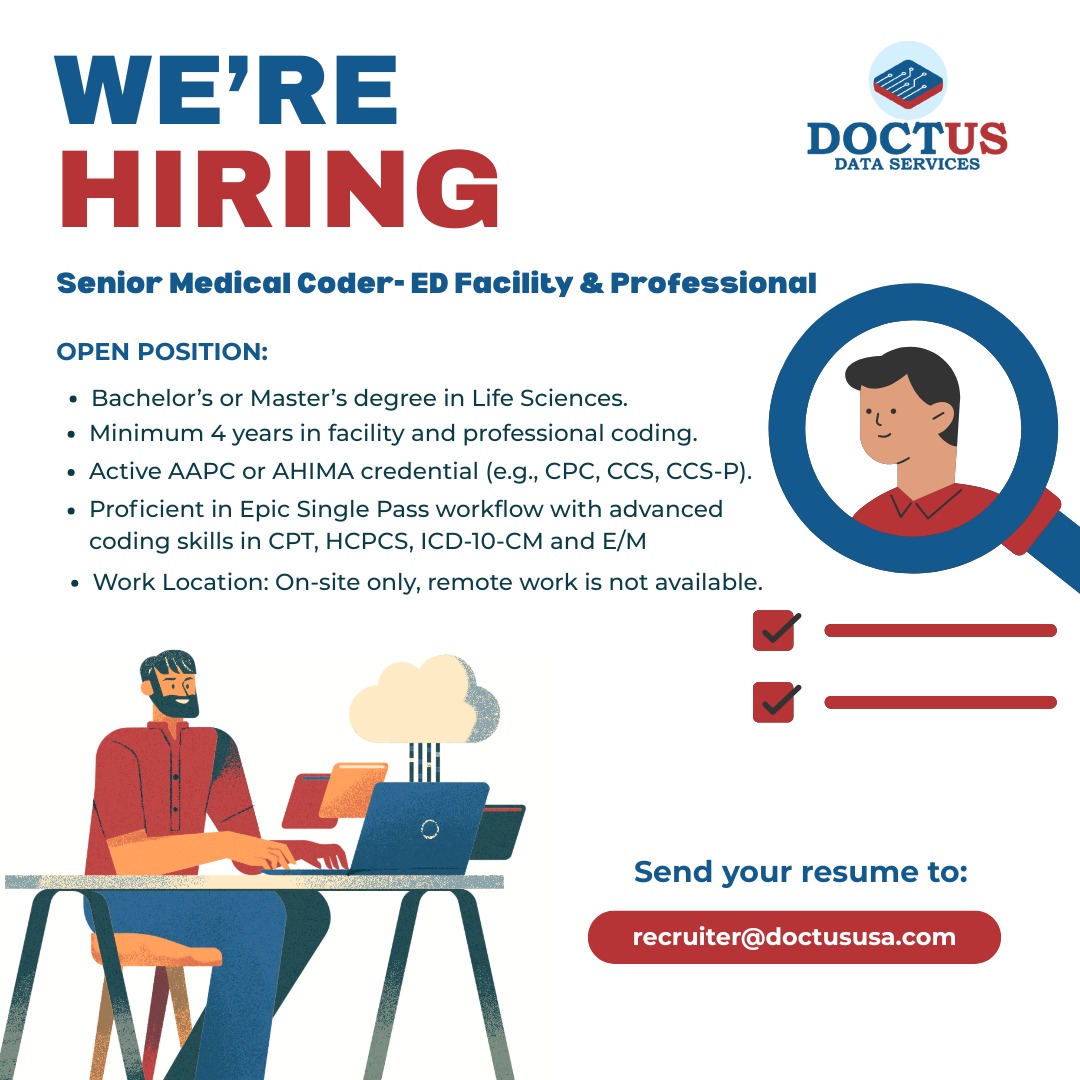
Position: Senior Medical Coder – ED Facility & Professional
This opening is specifically for experienced coders who specialize in Emergency Department (ED) services. The senior-level role requires strong command over both facility and professional coding, making it a highly responsible profile.
Below are the complete details of the job as mentioned in the hiring announcement.
Eligibility Criteria
To apply for this position, candidates must fulfill the following requirements:
1. Educational Qualification
Applicants must have either a Bachelor’s or Master’s degree in Life Sciences.
This includes degree backgrounds such as:
- Biotechnology
- Microbiology
- Biochemistry
- Nursing
- Pharmacy
- or any similar life science discipline
This ensures candidates have the medical foundation needed for interpreting clinical documentation accurately.
2. Experience Requirement – Minimum 4 Years
This position requires at least 4 years of experience in medical coding, specifically in:
- Facility coding
- Professional (ProFee) coding
ED coding involves working with a wide range of cases—from minor injuries to life-saving interventions—so the company expects candidates with strong practical exposure.
3. Mandatory Coding Certifications
Candidates must have an active certification from:
- AAPC (American Academy of Professional Coders)
Examples: CPC, CPC-A, CPMA
OR
- AHIMA (American Health Information Management Association)
Examples: CCS, CCS-P
These credentials demonstrate professional competence and are essential for working with US-based medical records.
4. Technical Skills Required
Doctus specifically highlights the need for proficiency in the Epic Single Pass workflow, a commonly used electronic health record (EHR) system in US hospitals.
In addition, candidates should be highly skilled in:
- CPT (Current Procedural Terminology)
- HCPCS coding
- ICD-10-CM diagnosis coding
- E/M (Evaluation and Management) coding
This makes it clear that the job is best suited for coders who handle complex coding structures and ED documentation regularly.
Work Location
One of the important points mentioned in the job notification is:
❗ Work Location: On-site only (remote work is not available)
This means the selected candidate must work from the company’s physical office. This could be ideal for individuals who prefer:
- A stable office routine
- Team collaboration
- Direct communication with supervisors
- Better access to training and support
Remote coders may need to reconsider, as the company currently does not offer a work-from-home option for this role.
Why This Job Opportunity Is Valuable for Experienced Coders
Medical coding is evolving rapidly with new guidelines, technology, and compliance requirements. Working with a professional organization like Doctus ensures exposure to:
- Latest coding standards (CPT, HCPCS, ICD-10-CM, E/M)
- Advanced EHR workflows such as Epic
- Regular audits and quality checks
- End-to-end Emergency Department coding workflows
- Highly collaborative team environments
For coders seeking career stability, professional growth, and hands-on exposure to US healthcare operations, this role is a strong opportunity.
Key Advantages of Joining Doctus Data Services
Here are some reasons why this job could be a great match:
✔ Reputed Healthcare Data Company
Doctus has established its presence in the healthcare outsourcing sector with a strong record of quality service.
✔ Senior Level Role
This position offers leadership-level experience, helping you grow in the medical coding domain.
✔ Skills Enhancement
You will get regular exposure to:
- Critical ED encounters
- High-volume facility coding
- Complex E/M leveling
- Compliance-driven auditing
✔ Structured Work Environment
Office-based roles often provide:
- Better teamwork
- Guidance from QA teams
- Opportunities for internal promotions
- In-person support and training
Who Should Apply?
You are the ideal candidate if:
- You have hands-on experience in both ED facility and professional coding.
- You are confident with Epic workflow and complex coding scenarios.
- You are looking for stable, long-term, on-site employment.
- You consistently code with high accuracy and meet productivity benchmarks.
How to Apply for This Job
The application process is simple and direct.
📩 Send your resume to:
Make sure your email includes:
- Updated resume
- Coding certification details
- Years of experience
- Your specialization in ED, E/M, CPT, or other areas
- Contact information
Pro tip:
Attach a brief cover letter explaining your ED coding experience. It will help your application stand out.
Basic Medical Coding Interview Questions
1. What is medical coding?
Medical coding is the process of translating clinical documentation into standardized codes (ICD-10-CM, CPT, HCPCS) for billing, reporting, and data analysis.
2. What is ICD-10-CM used for?
ICD-10-CM is used to report diagnosis codes for all healthcare settings.
3. What is CPT?
CPT (Current Procedural Terminology) is used to report procedures and services performed by providers.
4. What is HCPCS?
HCPCS (Healthcare Common Procedure Coding System) includes:
- Level I: CPT codes
- Level II: Supplies, drugs, DME, ambulance services
5. What is the difference between ICD-10-CM and CPT?
- ICD-10-CM: Identifies why the patient was seen (diagnosis).
- CPT: Identifies what service was performed (procedure).
6. What is a modifier?
A modifier provides additional information about a procedure without changing its definition.
7. What does modifier -25 mean?
Modifier -25 shows that a significant and separately identifiable E/M service was provided on the same day as a procedure.
8. What does modifier -59 mean?
Modifier -59 indicates distinct procedural service when procedures are bundled.
9. What is E/M coding?
Evaluation & Management coding is used to report office visits, ED visits, hospital visits, and other evaluation services.
10. What are the components of E/M coding?
For 2023+ guidelines:
- Medical Decision Making (MDM) OR
- Time
11. What is Medical Necessity?
It means the service provided must be reasonable, necessary, and supported by documentation.
12. What is upcoding?
Reporting a higher level of service or code than documented. This is non-compliant and considered fraud.
13. What is downcoding?
Reporting a lower level of service to avoid audits. This also impacts revenue.
14. What is a superbill?
A document that summarizes diagnosis and procedures to be billed.
15. What is NCCI?
NCCI stands for National Correct Coding Initiative, which prevents improper code combinations.
16. What is a denial?
A denial occurs when a claim is rejected by the payer due to:
- Incorrect codes
- Lack of documentation
- Invalid modifiers
- Medical necessity issues
17. What is DRG?
Diagnosis-Related Group – used in inpatient hospital billing to classify hospital cases.
18. What is the difference between inpatient and outpatient coding?
- Inpatient: Uses ICD-10-CM + ICD-10-PCS
- Outpatient: Uses ICD-10-CM + CPT + HCPCS
19. What are Add-On codes?
Codes that cannot be reported alone and must be billed with a primary procedure.
20. What are LCD/NCD?
- LCD: Local Coverage Determination
- NCD: National Coverage Determination
They define coverage rules for specific services.